

Using an ATLAS system to monitor, manage, & control the power use at your facility can lead to significant savings on your energy bills. ATLAS systems can also help you meet Energy Saving Opportunity Scheme (ESOS), ISO50001 & Demand Side Management requirements.
The range of Atlas Energy Management Systems consist of three component parts;
- Meters measuring electricity, gas, water or other resources measure use. Data-saving meters will also store 1/2 hourly energy use
- Loggers collect and store the 1/2 hourly energy usage information provided by the meters (where not already stored in data-saving meters).
- Software downloads/imports data from the loggers/meters, and provides comprehensive analysis tools.
The meters can be measuring use of any resource, be it electricity, gas, water, compressed air etc. Data can be gathered from any meter with a pulse output or Modbus capabilities. Data-saving, network connected meters can also be used to provide internal data storage.
Pulse outputs from meters are wired into (or sent wirelessly to) either an Atlas logger or GLAS logger where the pulses are counted and stored in the logger’s memory in 30 periods.
Atlas IV loggers also use the rate that pulses are received to calculate present load and predicted period demand figures.
Modbus capable meters are connected to a GLAS logger which reads each meter’s kWh/kVAh/etc register at each 1/2 hour to provide 30 minute period data. Data-saving meters are configured to store 1/2 hourly data internally.
Atlas loggers are polled by the data collection software at user determined intervals. The energy usage data is collected & stored permanently in the system database. GLAS loggers & data-saving meters are configured to upload data to an FTP Server as each 1/2 hour’s data becomes available. The AtlasComms data collection software monitors the FTP folders and imports any new data that becomes available.
Depending upon the hardware used, live present load data can also be gatherd via Modbus to provide frequently updated instantaneous kW/kVA values (for example).
All data is then available for analysis within the Atlas software.
In the case of the AtlasEMS energy monitoring system software, the front-end software can be installed on any number of network users’ PCs to enable them to analyse the data collected without leaving their desk. For example finance people can produce in house bills and production managers can confirm efficiency of manufacture.
ATLAS Energy Management Systems Typical layout
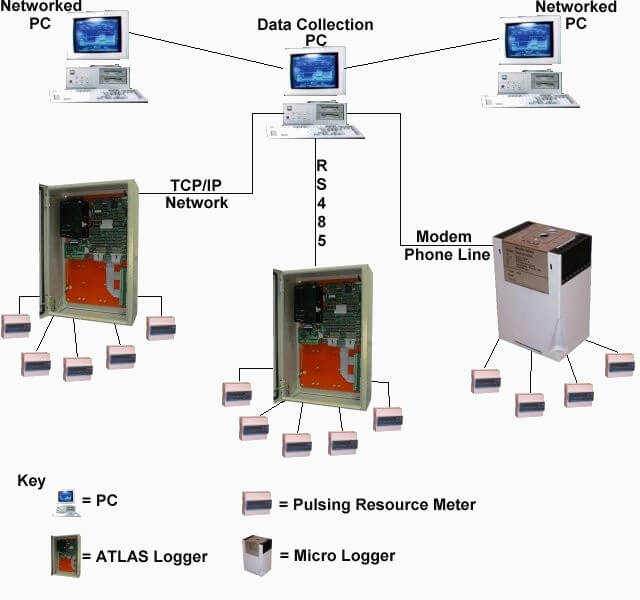
The diagram above shows the possible layout of AtlasEMS series energy management systems as well as the various data gathering/communication options available. Loggers can all be on the same site or at different physical locations, provided a network connection can be established.